IBC syntax
Demonstrates Quokka3's simplified IBC syntax across four domain types, from a minimal 2D geometry to a full-cell model with edge and perimeter effects.
This example demonstrates the simplified IBC syntax for modeling interdigitated back-contact cells, progressing through four domain types of increasing complexity. It starts from a minimal 2D IBC geometry and builds up to busbar, solder-pad, and full-cell representations.
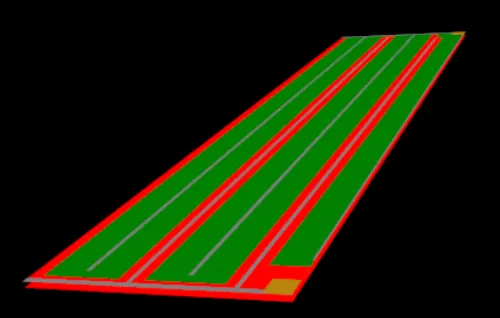
Interactive 3D model — rotate, pan, zoom.
The busbar-enhanced domain adds finger-length and busbar effects to the symmetry domain for optimizing finger and busbar pitch while accounting for finger resistance. The pad-enhanced domain incorporates solder pads and the associated busbar resistance losses. The multi-domain variant generates a full-cell geometry that is solved efficiently by applying a numerical mesh only in a few subdomains, allowing study of edge and perimeter effects.
What this example covers:
- A minimal 2D IBC symmetry geometry
- Busbar-enhanced domains for finger/busbar pitch and finger resistance
- Pad-enhanced domains for solder-pad placement and busbar resistance losses
- A full-cell multi-domain geometry for edge and perimeter effects
Resources